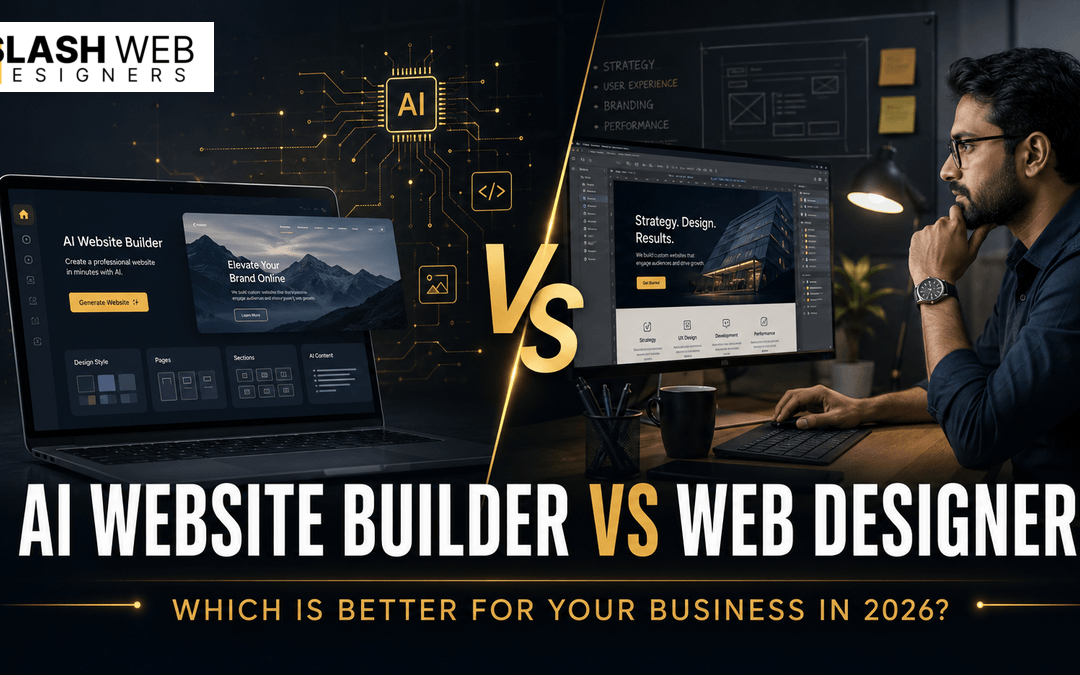
AI website builders are everywhere in 2026. Wix, Hostinger, Framer, Durable, and others now promise a full business website in minutes. For a busy owner, this sounds perfect — fast, cheap, and no need to hire anyone.
But a business website is not just pages on the internet. It has a job to do.
Your website needs to build trust, explain your services clearly, work well on mobile, rank on Google, collect enquiries, and make it easy for customers to contact you. A website that looks nice but does not bring leads is not doing its job.
So the real question is not “Can AI build a website?” The real question is “Can an AI website builder build the right website for your business goals?”
This blog will help you decide.
Table of Contents
What Is an AI Website Builder?
An AI website builder is a tool that uses artificial intelligence to create a website from a short prompt. You type in your business name, industry, services, and style. The tool then generates a layout, sections, copy, images, and basic SEO settings.
Wix says its AI website builder can turn a prompt into a business-ready site and still allow manual editing. Hostinger also markets its AI website builder as a way to launch a site in minutes.
An AI builder can usually handle:
Page layout
Basic website copy
Ready-made sections
Mobile responsive templates
Contact forms
Image suggestions
Basic meta titles and descriptions
Drag-and-drop editing
For a simple online presence, this is often enough. For a serious business website, it usually isn’t.
What Does a Professional Web Designer Do?
A professional web designer doesn’t start with layouts. They start with your business.
Before touching a design, a good web designer will study your services, your customers, your competitors, your pricing model, and your goals. Only then do they plan the site.
That planning covers:
Which pages your business actually needs
How the homepage should be structured
Where CTA buttons should appear
How users should move from one page to another
How forms should collect the right enquiries
How the site should support SEO from day one
How the design should build trust
How the site should behave on mobile
How leads should be tracked after launch
This is the real difference.
AI focuses on fast creation. A web designer focuses on business results.
AI Website Builder vs Web Designer: Quick Comparison
Factor
AI Website Builder
Professional Web Designer
Speed
Very fast
Takes more time
Cost
Lower upfront
Higher investment
Strategy
Basic or automated
Business-specific
Branding
Can look generic
Custom and unique
SEO
Basic features
Planned structure
Navigation
Auto-generated
Planned around buyer journey
Forms & Leads
Basic contact forms
Proper lead flow + tracking
Content
AI-generated
Human-edited, customer-focused
Scalability
Limited by platform
Easier to grow
Support
Platform-based tickets
Direct human expert
Best for
Simple websites
Growth-focused business websites
Benefits of AI Website Builders
Fast to Launch
The biggest benefit is speed. You can go from prompt to published in a day. This is useful when you need:
A temporary landing page
A simple personal website
A small portfolio
A basic startup site
A quick test for a new business idea
If your goal is only to get something online quickly, AI is a fine choice.
Lower Upfront Cost
AI builders cost less than hiring a designer. For a new business with a tight budget, this feels helpful.
But cost is not the only measure. A cheap website becomes expensive if it doesn’t bring enquiries, doesn’t rank, and has to be rebuilt in a year.
Easy for Non-Technical Users
Most AI builders are made for people with zero coding knowledge. You can edit text, swap images, move sections, and publish — all through simple controls.
Good for First Drafts
AI is genuinely useful for ideas. It can suggest sections, headings, copy angles, and design direction. Even professional web designers use AI as a support tool.
The problem starts when a business relies on AI alone, with no human planning behind it.
Limitations of AI Website Builders
Shallow Business Understanding
AI can build a general website, but it cannot deeply understand your business.
It usually doesn’t know:
What your customers really care about
Why people choose your service over competitors
What doubts customers have before enquiring
Which services are actually profitable for you
How your local competitors position themselves
What trust signals your website needs
A generic site is fine for a hobby. It’s a problem for a business that lives on leads.
Generic-Looking Websites
AI outputs often look clean — and identical. Same hero section, same three service cards, same testimonial strip, same contact block.
That’s not “wrong.” But if your website looks like every other business in your industry, customers won’t remember you.
An AI builder can create a contact form. But your business doesn’t need “just a form.” It needs a lead system.
A designer will think about:
Where the form appears on every page
Whether service pages need their own forms
How many fields to include
Whether users prefer call, WhatsApp, email, or booking
Whether the form connects to a CRM or email tool
Whether spam protection is added
Whether conversion tracking is set up
What happens after submission
For ecommerce, the stakes are even higher. Baymard Institute reports an average online shopping cart abandonment rate of 70.22% across 50 studies, and large ecommerce sites can lift conversions by 35.26% through better checkout design.
Forms and checkout flows directly affect revenue. AI-generated defaults rarely get this right.
Navigation That Doesn’t Match Buyer Journey
AI creates a menu automatically. But a clinic, a restaurant, a real estate firm, a school, and an IT services company should not all have the same menu.
Customers need to find:
Services
Pricing or packages
Location
Reviews
FAQs
Contact / booking
If your navigation is confusing, users leave. A designer plans the menu around how your customers actually make decisions.
Surface-Level SEO
Many AI builders include SEO fields. That’s not the same as SEO strategy.
Real SEO needs:
Keyword research
Search intent planning
Proper service page structure
Local SEO (especially for Hyderabad businesses)
Internal linking
Optimized headings
Fast page speed
Image optimization
Schema markup
Helpful, human-written content
A blog strategy
Google advises creating helpful, reliable, people-first content. Generic AI-written copy rarely meets that bar without expert editing.
A website has to load fast and behave well on phones.
Google’s Core Web Vitals measure loading performance, interactivity, and visual stability, and Google uses mobile-first indexing, meaning the mobile version of your site is what Google primarily crawls and ranks.
AI sites often look fine on desktop but break on mobile — buttons too small, forms cut off, spacing off, images too heavy. A designer tests all of this before launch.
Support Gaps After Launch
When forms stop working, tracking breaks, or rankings drop, you need someone who understands your business — not a chatbot from a platform.
A designer or small agency can help with:
Updates
Bug fixes
Speed improvements
New pages
SEO changes
Form testing
Tracking setup
Redesigns and maintenance
A business website is not a one-time project. It’s a long-term asset.
Related read: [Freelancer vs Web Design Agency: What’s Better for Your Business?]
Benefits of Hiring a Professional Web Designer
Strategy First, Design Second
A good web designer doesn’t start with colours. They start with questions.
Who is your target customer?
What services matter most?
What action should visitors take?
What pages are needed?
What objections do customers have?
What makes your business trustworthy?
The design flows from those answers.
Stronger Brand Trust
Your website creates the first impression of your business.
Stanford’s web credibility guidelines — based on research with more than 4,500 people — recommend that websites show a real organization, make contact easy to find, look professional, be easy to use, and avoid small errors.
Small design details compound into trust — or the lack of it. Customers do notice.
Better User Experience
UX is how easily people can use your site. A professional website should help visitors:
Understand what you offer within 5 seconds
Find the right service
Trust your business
Contact you without friction
Take the next step without thinking
That takes real planning.
SEO Built Into the Foundation
A designer builds the site with SEO baked in from day one:
Clean page hierarchy
Dedicated service pages
Clean URLs
Optimized headings
Strong internal links
Fast loading
Mobile-friendly layout
Schema markup
Blog structure
Local SEO signals
Adding SEO after launch is always harder — and usually more expensive.
Real Lead Generation Setup
A designer plans your website as a lead machine, not just an online brochure:
Clear CTA buttons
WhatsApp and call buttons on mobile
Service-specific enquiry forms
Trust sections
Testimonials and case studies
FAQs
Thank-you pages
Conversion tracking
A website doesn’t generate leads just by being online. It generates leads when it makes the next step easy.
When to Use an AI Website Builder
An AI website builder is a good fit if:
You need a basic site quickly
Your budget is very tight
You are testing a business idea
Your business doesn’t depend on website leads
You don’t need advanced SEO
You can handle updates yourself
You only need a simple online presence
There’s no shame in using AI for this. It’s the right tool for the right job.
When to Hire a Professional Web Designer
Hire a designer if:
Your website is a real source of leads or sales
You want a strong, professional brand image
You need SEO from the beginning
You need proper enquiry forms and lead capture
You need WhatsApp, call, CRM, or tracking integration
You want custom service pages
You want navigation planned around your customers
You need long-term support
You want the website to grow with your business
For most serious businesses, a designer gives better long-term value.
The Right Approach for Businesses in 2026
Here’s the honest take, no marketing spin:
Use AI as a support tool. Don’t rely on AI alone for a business website that has to generate leads, build trust, and grow with you.
The best websites in 2026 will use AI to speed up ideas, first drafts, and layouts. But strategy, planning, testing, and long-term improvement still need a human expert behind them.
Why Hyderabad Businesses Need to Choose Carefully
Hyderabad has serious competition in almost every industry — healthcare clinics in Jubilee Hills, restaurants in Gachibowli, real estate firms in Kondapur, coaching centres in Ameerpet, IT services companies in HITEC City, manufacturers on the outskirts.
Your customers compare businesses online before they call, walk in, or book. If your website looks generic, loads slowly, has weak content, or makes it hard to reach you, you will lose leads to competitors who invested more thought into theirs.
A professional website helps Hyderabad businesses improve:
Local SEO (“near me” and neighbourhood searches)
Brand trust
Service enquiries
Mobile experience
WhatsApp leads
Google visibility
Long-term growth
Final Verdict
AI website builders are useful for quick, simple websites. They save time and reduce upfront cost.
But if your website matters for growth, SEO, branding, customer trust, and lead generation, a professional web designer is the better choice.
A business website should not just be created fast. It should be planned properly, tested carefully, and improved over time.
At Slash Web Designers, we build professional, SEO-friendly, mobile-responsive websites for Hyderabad businesses — designed for trust, enquiries, and long-term growth.
Not sure whether an AI builder is enough, or whether your business needs a designer? [Talk to us for a free consultation] — we’ll give you an honest answer based on your goals, even if the answer is “AI is fine for now.”
FAQs
Is an AI website builder good for a business?
Yes, for a simple business website with basic requirements. But if your business needs strong SEO, unique branding, custom lead capture, and long-term support, an AI builder alone usually isn’t enough.
Can AI replace a web designer in 2026?
Not fully. AI can speed up website creation, but it cannot replace human strategy, business understanding, UX planning, or expert customization. Most serious sites still need a human behind them.
Is an AI-generated website SEO-friendly?
It can cover basics like meta titles and descriptions. But real SEO — keyword research, page structure, local SEO, internal links, speed, and helpful content — needs human planning.
Which is cheaper: AI website builder or web designer?
AI builders are cheaper upfront. A web designer costs more because the site is planned, customized, and optimized for your specific business goals. Long term, a well-designed site often pays for itself in leads.
Which is better for lead generation?
A professional web designer, in most cases. Designers plan CTAs, forms, trust sections, navigation, and tracking — the parts that actually convert visitors into enquiries.
Should small businesses in Hyderabad use AI website builders?
Small businesses can use AI for a quick start. But if your website is meant to generate consistent leads, build local trust, and rank on Google, working with a Hyderabad-based web designer is usually the better investment.
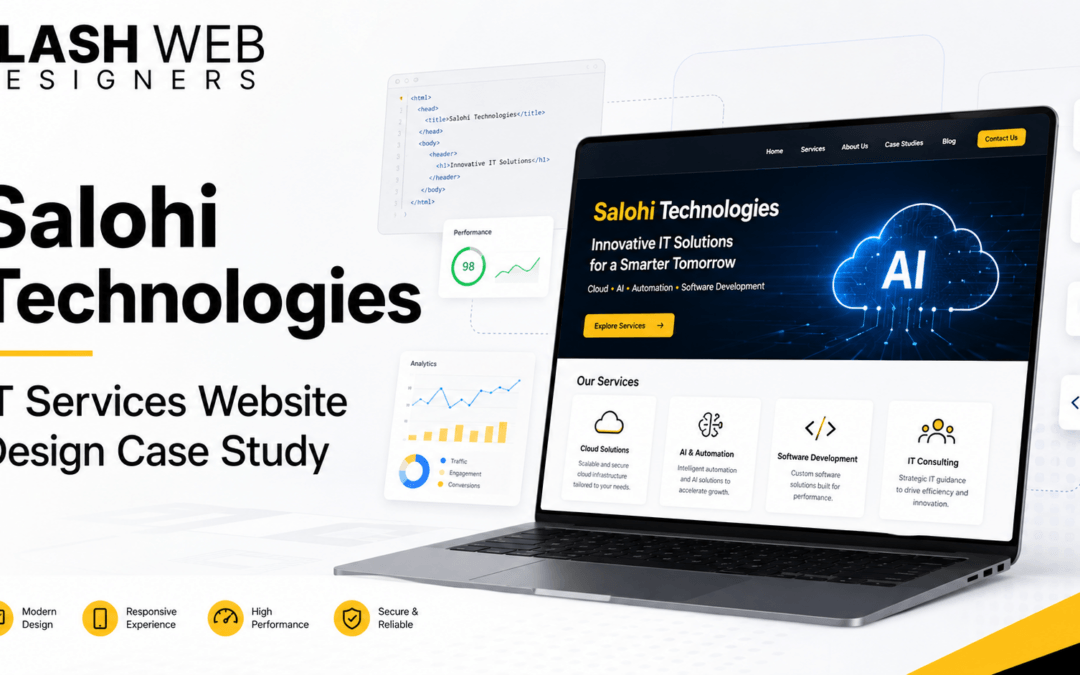
Creating a Digital Presence for a Modern AI and IT Services Company
As businesses continue to adopt cloud technologies, automation, data analytics, and artificial intelligence, technology service providers need websites that clearly communicate their expertise and capabilities. Salohi Technologies is one such company helping organizations modernize their operations through AI-driven solutions, business analytics, cloud infrastructure, DevOps practices, and full-stack software development.
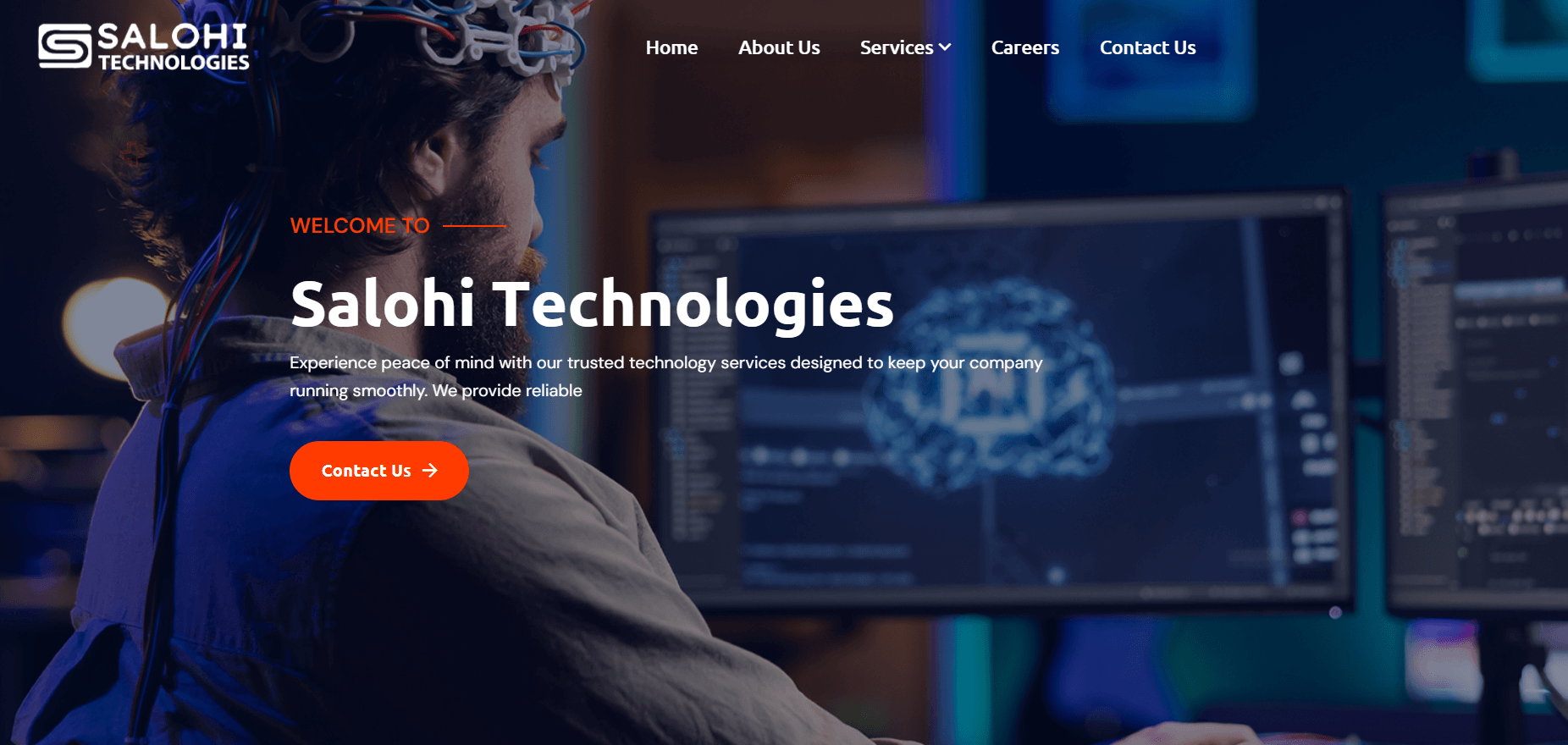
When Salohi Technologies partnered with Slash Web Designers, the objective was to create a website that reflected the company’s technical expertise while remaining accessible to business decision-makers. The goal was to build a professional digital platform that establishes credibility, explains complex services in a simple way, and encourages potential clients to start conversations with the team.
Looking to build a website that positions your technology company as an industry leader? Let's talk.
Salohi Technologies is a technology services company specializing in Artificial Intelligence, Business Analytics, Multicloud Infrastructure, DevOps, Python Full-Stack Development, SQL Solutions, and Generative AI services. The company focuses on helping organizations unlock business value through intelligent technology solutions and data-driven decision-making.
About the Client
Technology companies often face a unique challenge when it comes to their online presence. While their services may be highly technical, their clients are not always technical experts. Business leaders want to understand outcomes, value, and business impact rather than infrastructure architecture or programming frameworks.
Salohi Technologies operates in a space where trust and expertise are critical. Organizations investing in AI, analytics, cloud migration, or digital transformation need confidence that they are working with a capable technology partner. The website therefore needed to strike a balance between technical credibility and business-focused communication.
The challenge was to create a digital experience that explains sophisticated technology solutions without overwhelming visitors with jargon.
Challenges Faced
One of the primary challenges was presenting a diverse range of technology services under a single cohesive brand. Salohi Technologies offers expertise across multiple domains, including cloud computing, DevOps, data analytics, AI solutions, and software development. Without proper structure, visitors could easily struggle to understand the relationship between these services.
Another challenge involved building trust with prospective clients. Businesses evaluating technology partners often compare several providers before making a decision. The website needed to communicate professionalism, reliability, and technical competence from the first interaction.
The company also wanted to highlight its future-focused approach to AI and business analytics while maintaining a clean and professional corporate image. Creating this balance required careful attention to both content strategy and visual presentation.
Finally, the website needed to perform well across all devices. Decision-makers frequently browse company websites from mobile devices, tablets, and desktops, making responsiveness a critical part of the user experience.
Our Solution
Strategy
We started by understanding how business leaders evaluate technology service providers online. Most visitors are looking for answers to a few key questions: What does the company do? Can they solve my business challenges? Why should I trust them?
With these questions in mind, we structured the website around business outcomes rather than technical complexity. Instead of overwhelming visitors with industry terminology, we focused on clearly communicating the value each service delivers.
Design
The visual design was created to reflect innovation, professionalism, and trust.
We used a modern layout that allows visitors to quickly understand the company’s service offerings while maintaining a clean and organized browsing experience. Strategic content placement helps guide users through the website naturally, making it easy to explore services, learn about the company, and take action.
Special attention was given to showcasing Salohi Technologies’ expertise in AI and analytics, helping visitors immediately recognize the company’s core strengths.
Development
From a development perspective, the website was built with scalability and long-term growth in mind.
The structure allows the company to easily expand its content, add new service offerings, publish industry insights, and support future marketing campaigns. Navigation was simplified to ensure visitors can quickly access information without unnecessary clicks.
The website was also developed using SEO-friendly architecture, creating a strong foundation for future organic visibility and search engine performance.
Performance Optimization
Technology buyers expect fast and seamless digital experiences.
To meet these expectations, we optimized page performance, mobile responsiveness, and content delivery. The result is a website that loads efficiently and provides a consistent experience across smartphones, tablets, and desktop devices.
Key Features Delivered
Clear Technology Services Showcase
A structured service presentation was created to help visitors easily understand Salohi Technologies’ expertise in Artificial Intelligence, Business Analytics, Generative AI, Multicloud Infrastructure, DevOps, SQL Solutions, and Python Full-Stack Development. The website makes it simple for businesses to explore the services and understand how these solutions can support digital transformation.
AI, Analytics & Cloud-Focused Positioning
The website highlights Salohi Technologies’ core strength in AI, analytics, cloud, and software development in a clear and professional way. This helps position the company as a modern technology partner for businesses looking to improve operations, automate processes, and make smarter decisions with data.
Mission, Vision & Value Proposition
Dedicated content sections were added to present the company’s mission, vision, and value proposition. These elements help build trust and explain how Salohi Technologies supports organizations with practical, business-focused technology solutions.
Inquiry-Focused Website Structure
The website includes strategically placed inquiry opportunities that encourage visitors to connect with the team and discuss their technology requirements. This makes the website more useful for lead generation and helps potential clients take the next step easily.
Results & Impact
The completed website gives Salohi Technologies a professional digital presence that accurately reflects its capabilities and ambitions.
Visitors can now quickly understand the company’s service offerings, areas of expertise, and business value. The improved structure makes it easier for potential clients to navigate the website, learn about solutions, and initiate conversations.
The website also strengthens the company’s positioning as a trusted technology partner in areas such as AI, analytics, cloud computing, DevOps, and software development.
Most importantly, the platform serves as a powerful business development tool that supports credibility, lead generation, and long-term growth.
I gave them scope of work a week ago then got my startup business website designed today with free hosting. I didn’t expected this fast work. I paid extra for their efforts. Thanks again
Santosh Kumar
Salohi Technologies
Frequently Asked Questions
What was the goal of the Salohi Technologies website design project?
The goal was to create a professional website that clearly presents Salohi Technologies’ AI, analytics, cloud, DevOps, and software development services in a simple and business-friendly way.
How did Slash Web Designers improve the website structure?
Slash Web Designers organized the website content into clear service sections, improved navigation, and created a layout that helps visitors quickly understand the company’s expertise.
Why is professional website design important for technology companies?
A professional website helps technology companies build trust, explain complex services clearly, and generate inquiries from businesses looking for digital solutions.
What key features were delivered in this website project?
The website included a structured service showcase, AI and cloud-focused positioning, clear mission and vision sections, responsive design, and inquiry-focused content placement.
Was the website designed for business users or technical users?
The website was designed mainly for business decision-makers, while still presenting Salohi Technologies’ technical expertise in AI, analytics, cloud, DevOps, SQL, and full-stack development.
How can Slash Web Designers help IT and technology companies?
Slash Web Designers creates professional, conversion-focused websites that help IT and technology companies showcase services, build credibility, and attract potential clients.
Ready to Turn Your Technology Expertise Into Business Opportunities?
Your website should do more than describe your services. It should help potential clients understand your expertise, trust your capabilities, and feel confident about working with your team.
Whether you’re providing AI solutions, cloud services, analytics consulting, software development, or digital transformation services, Slash Web Designers can help you build a website that supports long-term growth.
Ready to create a website that drives more bookings and reflects the experience you offer?
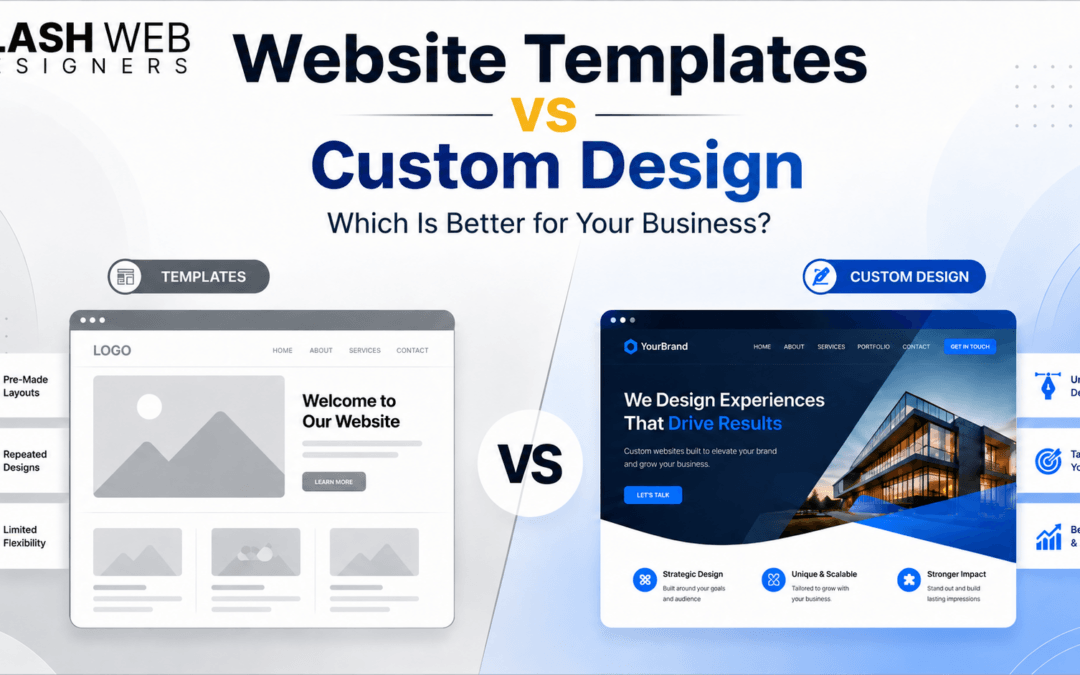
When a business owner plans to build a website, one common question comes up: should I use a ready-made website template or invest in a custom website design?
At first, a template website looks like the easier choice. It is faster, cheaper, and already has a design layout. You can change the text, images, colours, and launch the website quickly. For many small businesses, this sounds perfect.
But the real question is not only “Which option is cheaper?” The better question is: “Which option will help my business grow?”
A website is not just a digital visiting card. It should build trust, explain your services, rank on Google, work smoothly on mobile, and convert visitors into enquiries. If your website cannot do these things, it may look good but still fail as a business tool.
In this article, we will explain the difference between website templates and custom website design. We will also discuss cost, SEO, user experience, branding, scalability, and lead generation, so you can choose the right option for your business.
Table of Contents
Why This Decision Matters for Business Owners
Your website is often the first serious interaction between your business and your customer. Before a person calls you or visits your office, they may check your website to understand your services, quality, trust level, and professionalism.
This is why website design has a direct connection with credibility. Stanford’s web credibility guidelines, based on three years of research involving more than 4,500 people, recommend that websites should show a real organization, make contact details easy to find, look professional, be easy to use, and avoid small errors like broken links and spelling mistakes.
For a business owner, this means your website should not only be beautiful. It should be clear, useful, trustworthy, and easy to navigate.
A wrong website choice can affect your growth. For example, if you choose a template only because it is cheap, but later find that it is slow, difficult to customize, weak in SEO, or not suitable for lead generation, you may need to redesign the website again.
This is why the decision between template and custom design should be made carefully.
What Is a Website Template?
A website template is a ready-made website layout. It already has sections like header, banner, about, services, gallery, testimonials, blog, and contact form. You can replace the sample content with your own content.
Templates are available for WordPress, Wix, Squarespace, Shopify, HTML websites, and many website builders.
For example, if you need a basic website for a small business, you can choose a template, add your logo, update colours, write your service details, add contact information, and publish it.
When Are Website Templates Commonly Used?
Website templates are commonly used for personal portfolios, small brochure websites, temporary landing pages, event websites, basic startup websites, and businesses with very limited budgets.
They are useful when the business only needs a simple online presence and does not require advanced branding, SEO planning, custom features, or detailed conversion strategy.
What Is Custom Website Design?
Custom website design means the website is planned and designed based on your business goals, brand identity, target audience, services, and conversion needs.
A custom website does not start from a fixed ready-made layout. It starts with understanding your business. The designer and developer think about your users, your competitors, your services, your content, your call-to-action, and your future growth.
For example, a custom website for a clinic will not be planned the same way as a website for a resort, construction company, coaching institute, ecommerce store, or web design agency. Each business has different customers and different goals.
Custom design gives more control over layout, user flow, branding, SEO structure, page speed, content placement, and lead generation.
Website Templates vs Custom Design: Quick Comparison
Factor
Website Template
Custom Website Design
Cost
Lower initial cost
Higher initial investment
Time
Faster to launch
Takes more planning and development
Branding
May look common
Unique brand-focused design
SEO
Basic SEO possible
Stronger SEO structure possible
User Experience
Limited to template flow
Designed around customer journey
Scalability
Can become limited
Easier to scale
Lead Generation
Basic CTA placement
Conversion-focused layout
Best For
Simple websites
Growth-focused business websites
Benefits of Using Website Templates
1. Templates Are Budget-Friendly
The biggest benefit of a website template is cost. Since the design is already prepared, the business does not need to pay for a full custom design process.
For startups, small businesses, and personal brands with limited budgets, this can be helpful. A template can give you a basic online presence without a large upfront investment.
But business owners should remember one thing: low cost is useful only when the website meets your goal. If the website does not generate enquiries or support your business, the low cost may not give real value.
2. Templates Help You Launch Quickly
Templates are useful when you need a website quickly. Since the layout is already available, the designer or business owner can add content and launch faster.
This is useful for temporary campaigns, event pages, basic portfolios, or businesses that need a simple website immediately.
3. Templates Give a Ready-Made Structure
Many templates already include common website sections like hero banner, services, about us, gallery, testimonials, and contact form. This helps business owners who do not know where to start.
Instead of planning every section from zero, a template gives a basic structure.
4. Templates Are Good for Simple Websites
If your website only needs a few pages, such as Home, About, Services, and Contact, a template may work well.
For example, a small local business that does not depend heavily on website leads may start with a template and improve it later.
Limitations of Website Templates
1. Templates Can Look Generic
Many businesses use the same templates. If your website uses a common layout with only basic colour and text changes, it may look similar to many other websites.
This can reduce brand impact. A customer may not remember your website because it does not feel unique.
For businesses that want strong branding and a professional image, this is a serious limitation.
2. Limited Flexibility
Templates are built with a fixed structure. You can customize them to some extent, but not always fully.
Sometimes you may want to change a section layout, add a special form, create a unique service page, improve mobile structure, or build a custom landing page. The template may not support these changes easily.
This is where many business owners feel stuck.
3. SEO May Not Be Properly Planned
A template may look good visually, but that does not mean it is SEO-friendly.
SEO needs proper heading structure, clean URLs, fast loading speed, mobile-friendly layout, internal linking, keyword-focused content, optimized images, schema markup, and useful page structure.
Google recommends good Core Web Vitals because they measure real user experience in loading performance, interactivity, and visual stability. Google’s recommended targets include LCP within 2.5 seconds, INP under 200 milliseconds, and CLS below 0.1.
Many template websites fail because SEO is added later as an afterthought. A good business website should plan SEO before the design is finalized.
Some templates come with extra scripts, animations, plugins, unused sections, and heavy images. These things can slow down the website.
Website speed matters because users do not like waiting. Google has also clearly connected performance, loading, responsiveness, and visual stability with user experience through Core Web Vitals.
If your template is heavy, the website may look attractive but perform poorly.
5. Future Growth Can Become Difficult
A business website may start small, but later you may need more service pages, blog sections, landing pages, booking systems, payment gateways, CRM integration, WhatsApp tracking, or SEO campaigns.
A template may not always support this growth smoothly. You may need to rebuild the website later.
Benefits of Custom Website Design
1. Built Around Your Business Goals
The biggest benefit of custom website design is strategy.
A custom website starts with questions like:
What does your business offer?
Who is your target customer?
What problem does your customer want to solve?
What action should the visitor take?
Which services need separate pages?
Which keywords should the website target?
How should the website generate leads?
This planning makes the website stronger. It is not just designed for appearance. It is designed for business results.
2. Stronger Branding
Custom design helps your website match your brand properly. Your colours, typography, layout, images, icons, tone, and message can be designed in a unique way.
This is important because customers compare businesses online. A strong website can make your business look more professional and reliable.
Stanford’s guidelines also highlight that professional visual design, easy contact information, and useful user experience help improve website credibility.
3. Better User Experience
User experience means how easily visitors can use your website.
A good website should help visitors find information quickly. They should understand what you offer, why they should trust you, and how to contact you.
Custom design allows you to plan the user journey properly. For example, you can decide where to place CTAs, how to arrange service sections, how to show testimonials, where to add FAQs, and how to guide users from homepage to enquiry.
Google uses the mobile version of a website’s content for indexing and ranking, and it recommends responsive web design because it is easier to implement and maintain.
This means your custom website should be planned for mobile users from the beginning.
Custom design gives you more control over SEO structure.
You can plan service pages based on keywords, create proper H1/H2/H3 headings, optimize URL slugs, add internal links, improve content hierarchy, use schema markup, and structure the website for Google and users.
For example, a web design company in Hyderabad may need separate pages for:
Website design services in Hyderabad
Website development services in Hyderabad
Ecommerce website development
Website redesign services
SEO-friendly website design
Website maintenance services
This kind of structure is difficult when you only follow a fixed template.
5. Better Conversion Planning
A business website should convert visitors into leads.
This means your website should encourage users to call, fill out a form, send a WhatsApp message, book a consultation, or request a quote.
Custom design allows better CTA placement. You can add enquiry buttons after important sections, keep contact options visible, show trust signals, and reduce confusion.
For ecommerce websites, conversion planning is even more important. Baymard Institute reports an average online shopping cart abandonment rate of 70.22%, based on 50 studies, and says large ecommerce sites can gain a 35.26% conversion-rate increase through better checkout design.
This shows how much design and user experience can affect business results.
6. Easier to Scale
Custom websites can be planned for future growth.
If you want to add blogs, landing pages, online payment, ecommerce, booking, CRM, analytics, or marketing funnels later, a custom website gives better flexibility.
For growing businesses, this is important because your website should support your future marketing, not block it.
Limitations of Custom Website Design
1. Higher Initial Cost
Custom website design usually costs more than a template website. This is because it involves strategy, planning, design, development, testing, content structure, SEO setup, and revisions.
But for a serious business, this is not just a cost. It is an investment in branding, trust, visibility, and lead generation.
2. Longer Development Time
A custom website takes more time because it is not based on a ready-made layout.
The process may include requirement discussion, competitor research, wireframe planning, design, development, content placement, mobile testing, SEO optimization, and launch checks.
This time is important because a well-planned website performs better than a rushed website.
3. Requires the Right Team
Custom design works best when the team understands both design and business.
A website should not be created only by looking at design trends. It should be created by understanding your customers, your services, your local market, and your SEO goals.
This is where working with an experienced web design company becomes useful.
Which Option Is Better for SEO?
Both template websites and custom websites can rank on Google if they are properly optimized. The difference is in control and planning.
A template website can rank if it has good content, fast loading speed, mobile responsiveness, proper headings, clean URLs, and technical SEO.
But custom website design usually gives better SEO control because the structure is planned from the beginning. You can create keyword-focused pages, improve internal linking, optimize content flow, and design pages based on search intent.
Google’s guidance on AI-generated and web content also emphasizes accuracy, quality, relevance, helpful structure, metadata, structured data, and alt text.
This is important for modern SEO because people are searching not only on Google, but also through AI tools like ChatGPT, Gemini, and Perplexity. Clear headings, direct answers, FAQs, and helpful explanations make your content easier for both search engines and AI tools to understand.
Which Option Is Better for User Experience?
Templates provide a basic user flow. This may be enough for simple websites.
But custom design gives a business-specific user flow. It allows you to design the homepage, service pages, forms, CTAs, testimonials, FAQs, and navigation based on your customers.
For example, a hospital website, school website, real estate website, and web design agency website should not follow the same user flow. Each business has different users and different conversion goals.
A custom website helps you plan this properly.
Which Option Is Better for Lead Generation?
If your website is only for basic information, a template may be enough.
But if your website is expected to generate enquiries, custom design is usually better. Lead generation needs planning. It needs strong headlines, trust-building sections, service explanations, testimonials, simple forms, WhatsApp buttons, and clear CTAs.
A custom website can guide the visitor step by step:
First, understand the problem.
Then, trust your business.
Then, explore the service.
Then, take action.
This is how a website becomes a sales asset.
Want a website that is designed for leads, not just looks? Contact Slash Web Designers for SEO-friendly website design services in Hyderabad.
You can choose a website template if your budget is low, your timeline is short, and your website requirement is simple.
A template is suitable when:
You need a basic website quickly.
You do not need advanced features.
You are testing a new business idea.
You only need an online presence.
You are okay with limited customization.
You do not depend heavily on SEO or website leads.
Templates are not bad. They are useful in the right situation. The problem starts when a business expects a basic template website to perform like a custom growth-focused website.
When Should You Choose Custom Website Design?
You should choose custom website design if your website is important for leads, branding, SEO, and long-term business growth.
Custom design is better when:
You want a unique brand identity.
You want to rank on Google.
You need service-specific pages.
You need better user experience.
You want more enquiries.
You need future scalability.
You want a professional business website.
You are planning digital marketing campaigns.
For serious business websites, custom design gives more long-term value.
What Should Businesses Choose in 2026?
In 2026, businesses should choose based on their goals, not only based on price.
A template website is good for a quick and simple start. A custom website is better when your business needs trust, branding, SEO, lead generation, scalability, and long-term digital growth.
There is also a balanced option. Some businesses can start with a premium template and customize it professionally. This can reduce cost while still improving branding, speed, SEO, and user experience.
But if your website is central to your sales and marketing, custom design is usually the better choice.
Why Business Owners in Hyderabad Should Think Carefully
Hyderabad has become a highly competitive business market. Whether you run a clinic, institute, restaurant, real estate company, IT service, manufacturing business, or local service company, your customers are checking you online.
If your competitors have better websites, better service pages, better reviews, better UX, and stronger SEO, they may get the enquiry before you.
For Hyderabad businesses, a website should support local SEO terms like:
Website design company in Hyderabad
Website development services in Hyderabad
Ecommerce website development Hyderabad
SEO-friendly website design Hyderabad
Website redesign services Hyderabad
This is why a professional website should be planned with both design and SEO in mind.
Conclusion
Website templates and custom website design both have their place.
Templates are useful when you need a simple website quickly and at a lower cost. They are good for basic online presence, small projects, and temporary pages.
Custom website design is better when your website needs to support branding, SEO, user experience, lead generation, and long-term growth.
A business website should not be selected only by looking at the initial price. It should be selected by looking at your business goal.
If your website is expected to bring enquiries, build trust, rank on Google, and support your marketing, custom website design is usually the smarter investment.
At Slash Web Designers, we help businesses in Hyderabad build websites that are professional, SEO-friendly, mobile-responsive, and designed to generate quality leads.
1. What is the difference between a website template and custom website design?
A website template is a ready-made layout that can be edited with your content, images, and colours. Custom website design is planned from scratch based on your business goals, branding, audience, services, and SEO needs.
2. Are website templates good for business websites?
Yes, website templates can be good for simple business websites with basic requirements. But if your website needs strong branding, SEO, custom features, or lead generation, custom design is usually better.
3. Is custom website design better for SEO?
Custom website design can be better for SEO because the website structure, headings, content flow, speed, internal linking, and service pages can be planned from the beginning.
4. Is a template website cheaper than a custom website?
Yes, a template website is usually cheaper because the design is already prepared. Custom websites cost more because they require planning, design, development, testing, and SEO setup.
6. Which is better for small businesses: template or custom design?
For a very small business with a limited budget, a template can be a good start. For a small business that wants leads, local SEO, better branding, and long-term growth, custom design is better.
7. When should I choose custom website design?
Choose custom website design when your website is important for sales, enquiries, branding, SEO, and future growth.
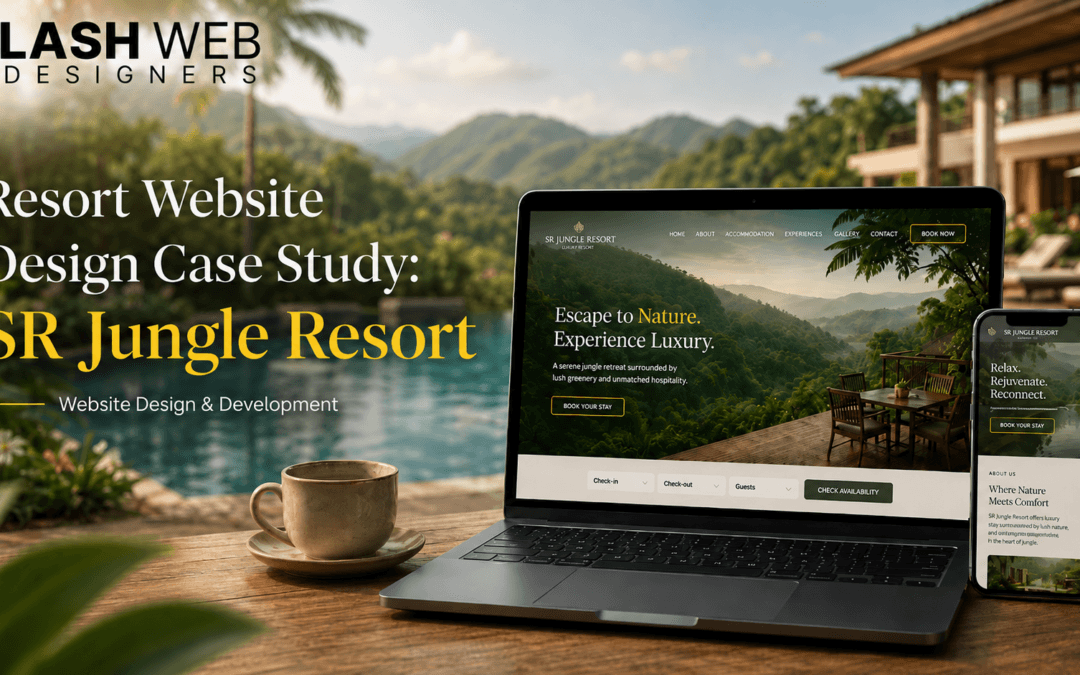
Helping SR Jungle Resort Create a Digital Experience as Memorable as the Destination
Located in the scenic hills of Anaikatti near Coimbatore, SR Jungle Resort offers guests a unique blend of nature, comfort, adventure, and relaxation. Spread across 35 acres in the Western Ghats, the resort attracts families, couples, corporate groups, and travelers looking to escape city life and reconnect with nature.
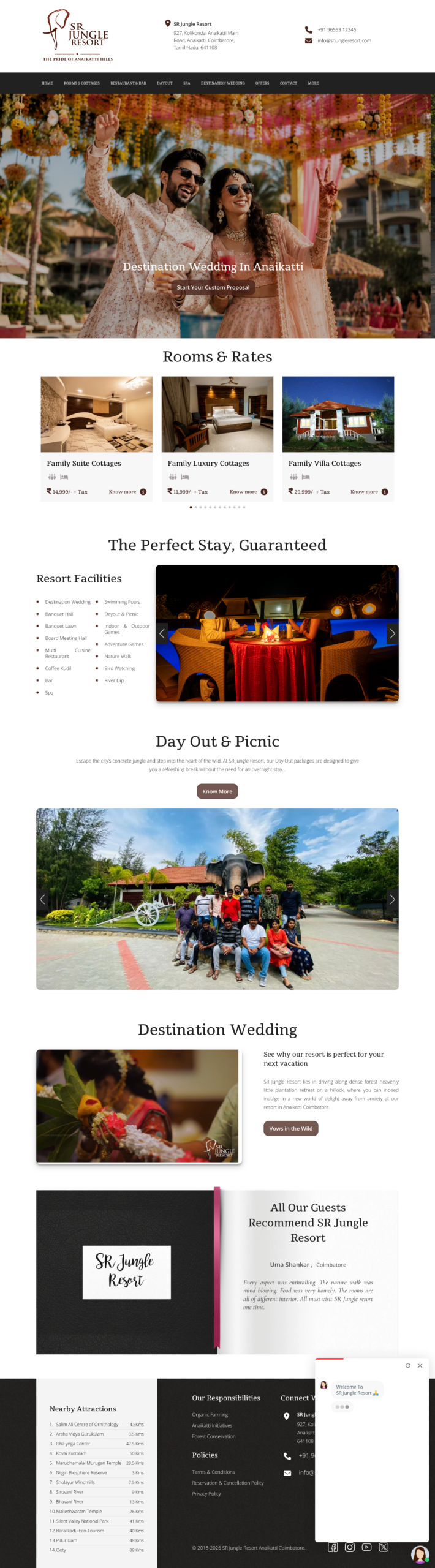
When SR Jungle Resort needed a website that truly reflected the experience they offer guests, Slash Web Designers partnered with them to build a platform that showcases their accommodations, amenities, activities, and event facilities while making it easier for visitors to explore the resort and make booking decisions.
Want a website that inspires more bookings and inquiries? Let's build a digital experience your guests will remember.
SR Jungle Resort is a nature-focused destination located in the beautiful Anaikatti region of Coimbatore. Surrounded by greenery and hills, the property offers a wide range of accommodations, recreational activities, dining options, event spaces, and wellness experiences for guests of all age groups. The resort is designed to provide a peaceful retreat while still offering modern comforts and entertainment.
About the Client
The hospitality industry has become increasingly competitive over the last few years. Travelers no longer choose resorts based solely on recommendations. Most booking decisions begin online, where guests compare multiple properties before making an inquiry or reservation.
For a destination like SR Jungle Resort, the website plays a critical role in shaping first impressions. Potential guests want to see the rooms, understand the facilities, explore nearby attractions, learn about available activities, and feel confident that the resort can deliver the experience they are looking for.
The challenge was not simply to create an attractive website. The goal was to build a platform that captures the atmosphere of the resort while helping visitors quickly find the information they need to make a booking decision.
Challenges Faced
One of the biggest challenges was presenting the resort’s wide range of offerings in a clear and organized way. SR Jungle Resort is much more than just accommodation. It offers cottages, suites, swimming pools, restaurants, adventure activities, nature walks, bird watching, day-out packages, wedding facilities, banquet halls, corporate meeting spaces, and wellness experiences.
Without proper structure, visitors could easily feel overwhelmed by the amount of information available.
Another challenge was helping potential guests understand the unique experience offered by the resort. The peaceful location in Anaikatti, the surrounding natural beauty, the family-friendly environment, and the combination of relaxation and adventure needed to be communicated effectively through the website.
Mobile usability was also an important consideration. Many travelers search for resorts and vacation destinations directly from their smartphones. The website needed to provide a smooth experience across all screen sizes without compromising performance or usability.
Our Solution
Strategy
We started by understanding how potential guests interact with resort websites. Most visitors arrive with specific questions in mind. They want to know what the rooms look like, what activities are available, whether the property is suitable for families or couples, and how they can make a reservation.
With this in mind, we structured the website around the guest journey. Information was organized in a way that helps visitors naturally move from discovery to inquiry.
Design
The design approach focused on showcasing the resort experience rather than simply listing amenities.
Large visuals, clear navigation, and thoughtful content placement were used to help visitors experience the atmosphere of the resort even before arriving at the property. Every section was designed to highlight the beauty of the location while maintaining a clean and professional appearance.
Special attention was given to showcasing accommodation options, recreational activities, and event facilities in a way that feels engaging rather than overwhelming.
Development
During development, we focused on creating a website that is easy to manage and scalable for future growth.
The website was built with performance and usability in mind. Navigation was simplified, booking-related information was made easily accessible, and pages were optimized for smooth browsing across desktop and mobile devices.
The structure also supports future content expansion, allowing the resort to add new rooms, packages, activities, events, or promotional campaigns as the business continues to grow.
Performance Optimization
A resort website relies heavily on visual content, which can often affect loading speed. To address this, we implemented performance-focused development practices to ensure that visitors can browse images, accommodation details, and activity information without unnecessary delays.
Mobile responsiveness was prioritized throughout the project to ensure a consistent experience regardless of device.
Key Features Delivered
Clear Accommodation Showcase
A dedicated accommodation showcase was created to help visitors easily explore the different room and cottage categories available at SR Jungle Resort. From family cottages and honeymoon suites to corporate accommodations and dormitory options, the website makes it simple for guests to understand their stay options and choose what suits them best.
Amenities & Guest Experiences
The website highlights the resort’s wide range of amenities and experiences in a clear and engaging way. Nature walks, bird watching, swimming pools, adventure games, organic farm visits, river experiences, campfires, and tribal cultural programs are presented to help guests picture the experience before making a booking decision.
Weddings, Events & Corporate Facilities
Dedicated sections were added for weddings, private events, conferences, and corporate gatherings. Since SR Jungle Resort serves both leisure and business guests, the website clearly showcases banquet halls, board meeting facilities, destination wedding spaces, and group event options.
SEO-Friendly Website Structure
The website was developed with an SEO-friendly structure to help search engines better understand the resort’s services, accommodations, facilities, experiences, and location. This gives the website a stronger foundation for location-based and hospitality-related search visibility.
Results & Impact
The completed website provides SR Jungle Resort with a much stronger digital presence that accurately reflects the experience offered at the property.
Visitors can now explore accommodations, discover activities, learn about facilities, and understand the overall resort experience through a well-structured and visually engaging platform.
The website supports the resort’s marketing efforts by serving as a central destination for potential guests, event planners, families, couples, and corporate groups looking for accommodation in Anaikatti.
Most importantly, the website creates confidence. It helps visitors understand what makes SR Jungle Resort unique and encourages them to take the next step toward making a reservation or inquiry.
Frequently Asked Questions
1. What was the goal of the SR Jungle Resort website design project?
The goal was to create a professional resort website that clearly showcases the property’s accommodations, amenities, activities, event spaces, and location while helping visitors make informed booking decisions.
2. What key features were included in the resort website?
The website included dedicated sections for accommodations, amenities, activities, weddings, corporate events, guest experiences, and booking-related information. The structure was designed to make it easy for visitors to explore the resort and take the next step.
3. How does a professional website help resorts get more inquiries?
A professional resort website helps visitors understand the property, view stay options, explore facilities, build trust, and contact the resort more confidently. This can support more direct inquiries and booking opportunities.
4. Was the SR Jungle Resort website designed for mobile users?
Yes. The website was developed with mobile responsiveness in mind so guests can browse accommodations, activities, and contact details smoothly from smartphones and tablets.
5. Is SEO important for resort and hotel websites?
Yes. An SEO-friendly website structure helps search engines understand the resort’s location, services, accommodations, and facilities. This creates a stronger foundation for appearing in relevant hospitality and location-based searches.
6. Can Slash Web Designers build websites for other resorts and hotels?
Yes. Slash Web Designers creates professional websites for resorts, hotels, homestays, retreats, and hospitality businesses that want to showcase their property clearly and generate more inquiries.
Turn More Website Visitors Into Resort Guests
Whether you run a resort, hotel, luxury stay, eco-retreat, or vacation property, your website is often the first step in a guest’s booking journey. A professionally designed website can showcase your property, build trust, and encourage direct inquiries and reservations.
Ready to create a website that drives more bookings and reflects the experience you offer?
When a business owner plans to build a website, one common question comes up: should I hire a freelancer or a web design agency?
At first, both options may look similar. A freelancer can design a website, and a web design agency can also design a website. But the real difference is not only in the design. The difference is in planning, strategy, quality, communication, SEO, maintenance, and long-term support.
For many business owners, a website is not just a one-time project. It is a business asset. It helps customers find your business, understand your services, trust your brand, and contact you. That is why choosing the right website partner is very important.
A low-cost website may look attractive in the beginning, but if it does not generate leads, load fast, rank on Google, or support your business growth, it may cost you more in the long run.
In this article, we will explain the difference between a freelancer and a web design agency in simple English, so you can make the right decision for your business.
Why Choosing the Right Website Partner Matters
Your website is often the first impression of your business. Before a customer calls you, visits your office, or sends an enquiry, they may check your website.
If the website looks professional, loads fast, explains your services clearly, and gives easy contact options, the customer feels more confident. But if the website looks outdated, confusing, slow, or incomplete, the visitor may leave and choose another business.
This is why web design is not only about colours and images. A good website needs proper structure, user experience, mobile responsiveness, SEO planning, content, speed optimization, security, and regular maintenance.
A freelancer may be suitable for some small projects. But for businesses that need a professional, SEO-friendly, and lead-generating website, a web design agency often provides a more complete solution.
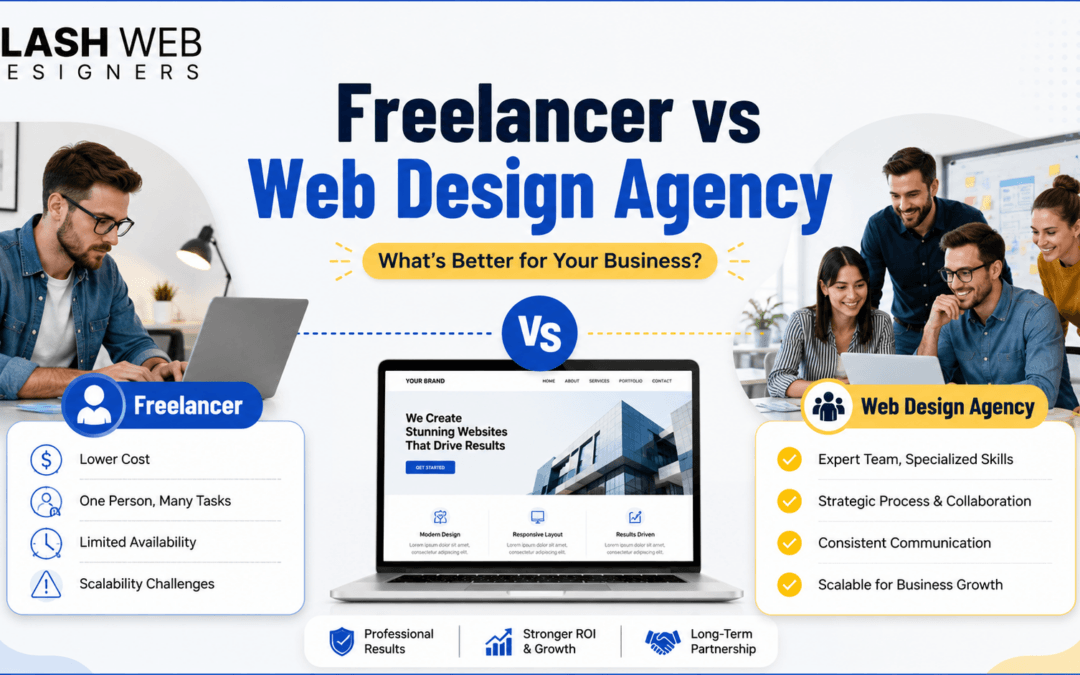
Freelancer vs Web Design Agency: Quick Comparison
Before going into details, let us understand the basic difference.
A freelance web designer is usually an individual professional who works independently. They may handle design, development, communication, and changes on their own.
A web design agency is a team of professionals. An agency may include designers, developers, SEO experts, content writers, project managers, and support staff. This gives the business a more structured and reliable website development process.
Both have advantages. The right choice depends on your business goals, budget, timeline, and expectations.
What Is a Freelance Web Designer?
A freelance web designer is an independent person who offers website design or development services. Freelancers usually work with multiple clients on a project basis.
They may be good for small websites, landing pages, personal portfolios, basic brochure websites, or simple design tasks.
The biggest advantage of hiring a freelancer is cost. Freelancers usually charge less than agencies because they have fewer overhead costs. For a small business with a very limited budget, this can look like an easy option.
But the challenge is that one person may not be an expert in everything. Website design needs many skills, such as UI design, development, SEO, speed optimization, content structure, mobile responsiveness, security, and technical maintenance. A freelancer may be strong in one area but weak in another.
What Is a Web Design Agency?
A web design agency is a professional company that provides complete website design and development services. Instead of depending on one person, an agency usually works with a team.
A web design agency can handle strategy, design, development, SEO, content guidance, testing, launch, and support. This makes the process more organized.
For business owners, this is important because they do not just need a website that looks good. They need a website that supports business growth.
A good web design agency understands how to design a website for users, search engines, and conversions. This means the website should be easy to use, easy to find on Google, and easy for visitors to contact your business.
Key Differences Between a Freelancer and a Web Design Agency
The choice between a freelancer and an agency should not be based only on price. You should look at the complete value. Below are the key areas where both options are different.
1. Cost and Budget
Freelancers are usually cheaper than agencies. If your requirement is very simple and your budget is low, a freelancer may be enough.
But cost should not be the only factor. A cheap website that does not bring enquiries, does not rank on Google, or needs frequent fixes can become expensive later.
A web design agency may charge more, but the cost usually includes planning, design, development, quality testing, SEO structure, mobile responsiveness, and support. This gives better long-term value.
For business owners, the real question should not be “Who is cheaper?” The better question is “Which option will give me a website that supports my business goals?”
2. Skill Set and Expertise
A website needs different skills. It needs good layout design, proper coding, SEO-friendly structure, user experience, content placement, website speed, and security.
A freelancer may be skilled, but one person may not cover all these areas deeply. For example, a freelancer may design a beautiful website but may not understand SEO. Another freelancer may be good at coding but weak in design or content structure.
A web design agency usually has different people for different tasks. A designer handles the look and feel. A developer builds the website. An SEO expert checks the structure. A content person may guide the messaging. This teamwork improves the final quality.
This is very important in web designing because every part of the website affects performance. Design, development, and SEO should work together.
3. Project Management and Communication
Website projects need clear communication. Business owners need updates, timelines, approvals, revisions, and proper handover.
With freelancers, communication can sometimes become difficult if they are busy with multiple projects or working alone. If they are unavailable, the project may get delayed.
A web design agency usually follows a more structured process. There may be a project manager or dedicated contact person who coordinates the work. This makes communication easier and more professional.
For business owners, this saves time. You know what is happening, when the work will be completed, and what is required from your side.
4. Website Design Quality
A professional website should not only look attractive. It should also be easy to use, mobile-friendly, fast, and conversion-focused.
Some freelancers can create good designs, but the quality may depend on their personal experience and skill level. If the freelancer does not understand business goals, the website may look nice but fail to generate leads.
A web design agency usually starts with business goals. They try to understand your target audience, services, competitors, and conversion needs. Then they design the website accordingly.
This is important because a business website should guide users. The homepage, service pages, CTAs, forms, images, and content should all help visitors take the next step.
5. SEO and Marketing Support
This is one of the biggest differences.
Many websites are designed without SEO planning. They may look good, but they do not rank on Google. For a business, this is a problem because the website will not get organic traffic.
A freelancer may or may not understand SEO. Some freelancers focus only on design and development. They may not optimize headings, URLs, meta tags, internal links, image alt text, loading speed, or page structure.
A professional web design agency usually understands the connection between web design and SEO. An SEO-friendly website is built in a way that search engines can understand easily.
At Slash Web Designers, we focus on creating websites that are not only visually professional but also search-friendly. This helps businesses build a strong online presence from the beginning.
Want a website that looks professional and is built for Google visibility? Contact Slash Web Designers for SEO-friendly website design services in Hyderabad.
Website delivery depends on planning, resources, and availability.
A freelancer may deliver quickly for small projects. But if the project becomes bigger or needs multiple changes, delays can happen because everything depends on one person.
An agency has a team, so work can be divided. Design, development, content updates, testing, and corrections can move in a more organized way.
Reliability is also important after the website is launched. If something breaks, if a plugin creates an issue, or if you need a quick change, an agency is more likely to have a support system.
For business websites, delivery should not only be fast. It should be proper. A website should be tested before launch for mobile view, speed, forms, links, browser compatibility, and basic SEO.
7. Website Maintenance and Long-Term Support
A website needs maintenance after launch. It may need plugin updates, security checks, backups, content changes, speed improvement, bug fixes, and SEO updates.
Many business owners ignore this point. They only focus on website launch. But after a few months, problems may start if the website is not maintained.
With freelancers, long-term support can be uncertain. Some freelancers may move to other jobs, become unavailable, or stop taking small update requests.
A web design agency usually provides ongoing maintenance and support. This is helpful for businesses that want peace of mind.
A website is not a one-time design file. It is a live business tool. Regular maintenance keeps it secure, updated, and useful.
8. Scalability for Business Growth
Your business may start with a basic website. But later, you may need more pages, landing pages, blogs, SEO, ecommerce features, payment gateway, booking system, CRM integration, or marketing campaign pages.
A freelancer may be able to handle small additions, but scaling a website requires planning and technical understanding.
A web design agency can help you plan for future growth. They can build the website structure in a way that supports new pages, SEO expansion, and business growth.
This is especially important for growing businesses in Hyderabad that want to use their website for leads, branding, and digital marketing.
When Should You Hire a Freelancer?
Hiring a freelancer can be a good option when your project is small and simple.
For example, you may hire a freelancer if you need a personal portfolio, a simple landing page, a small brochure website, minor design changes, or a short-term task.
A freelancer can also be suitable when your budget is very limited and you do not need advanced SEO, ongoing support, custom design strategy, or long-term planning.
But before hiring a freelancer, check their portfolio, communication style, experience, timeline, and support policy. Also ask whether they will provide basic SEO setup, mobile responsiveness, and post-launch support.
When Should You Hire a Web Design Agency?
You should consider hiring a web design agency when your website is important for your business growth.
If you want a professional business website, SEO-friendly structure, strong branding, service pages, landing pages, ecommerce features, content guidance, mobile optimization, and ongoing support, an agency is usually a better choice.
An agency is also a better option when you want a proper process. This includes requirement discussion, design planning, content structure, development, testing, launch, and maintenance.
For business owners, this gives more confidence. You are not depending on one person. You are working with a team that understands how business websites should perform.
Planning to build or redesign your business website? Slash Web Designers can help you create a fast, mobile-friendly, SEO-optimized website that supports your business growth.
Why Business Owners in Hyderabad Should Think Beyond Low Cost
Hyderabad has many growing businesses, startups, service providers, educational institutes, clinics, restaurants, real estate companies, manufacturers, and local service brands.
Most customers now search online before contacting a business. They compare websites, reviews, services, and trust signals. If your website does not create a good impression, you may lose leads to competitors.
This is why Hyderabad business owners should think beyond low-cost website design. A website should represent your brand professionally. It should be easy to use, easy to find on Google, and easy to contact.
A cheap website may save money today, but a strategic website can generate leads for years.
If your website is designed properly, it can support Google rankings, paid ads, social media campaigns, WhatsApp enquiries, and customer trust.
Which Option Is Better for Your Business Website?
There is no one answer for every business.
A freelancer may be better if your requirement is small, simple, and budget-focused.
A web design agency is better if your website is connected to your business growth, lead generation, SEO, branding, and long-term digital presence.
For most serious business websites, an agency gives better value because it provides a complete approach. You get design, development, SEO structure, testing, support, and future scalability.
The right choice depends on what you expect from your website. If you only want an online presence, a freelancer may be enough. But if you want a website that builds trust, ranks better, and generates enquiries, a web design agency is usually the better option.
Final Thoughts
Choosing between a freelancer and a web design agency is an important business decision.
A freelancer can be useful for small and simple projects. But if you want a professional website that supports your business, improves your online presence, and helps you generate leads, working with a web design agency is often the smarter choice.
A good website needs more than design. It needs planning, SEO, speed, user experience, mobile responsiveness, content structure, security, and support.
At Slash Web Designers, we help businesses in Hyderabad build websites that are clean, professional, SEO-friendly, and designed for growth.
Need expert guidance for your business website? Get in touch with Slash Web Designers today and build a website that works for your brand, your customers, and your long-term growth.
1. Is it better to hire a freelancer or a web design agency?
It depends on your project. A freelancer may be suitable for small and simple websites. A web design agency is better for business websites that need professional design, SEO, reliability, and long-term support.
2. Why is a web design agency more expensive than a freelancer?
An agency usually has a team of designers, developers, SEO experts, and support staff. The cost is higher because the service is more complete and structured.
3. Can a freelancer build an SEO-friendly website?
Some freelancers can build SEO-friendly websites, but not all freelancers specialize in SEO. If SEO is important for your business, make sure the person or company understands technical SEO, content structure, speed, and mobile optimization.
4. Which is better for a business website in Hyderabad?
For a serious business website in Hyderabad, a web design agency is usually a better option because it can provide strategy, design, development, local SEO support, and ongoing maintenance.
5. What should I check before hiring a web design agency?
Check their portfolio, website design process, SEO knowledge, service pages, client reviews, support options, pricing clarity, and ability to understand your business goals.
6. Is a low-cost website good for business?
A low-cost website may be fine for a basic online presence, but it may not support SEO, lead generation, user experience, or long-term growth. For business results, quality and strategy matter more than only low price.